On 12 February, India’s main trade union confederations, including AITUC, CITU, INTUC and HMS, in addition to sectoral federations (such as the All-India Bank Employees Association) and farmer organisations, jointly held a national general strike. The labour leaders claim that 300 million participated. But what is the balance sheet of the strike? And where do we go from here?
This action was directed against the Modi government’s efforts to dilute India’s labour laws, its recent trade deals with the US and EU – which represent massive concessions to foreign capital – and other policies that will add to the impoverishment of workers and farmers.
The all-India strike was supported by most major workers’ organisations in India, as well as bodies representing farmers, like Samyukta Kisan Morcha and All-India Kisan Sabha. Only the BMS (Bharatiya Mazdoor Sangh) – the largest trade union in India, which is ideologically aligned with the ruling RSS-BJP clique – did not support this strike.
In fact, it explicitly opposed the action, which it described as politically motivated. BMS is a strike-breaking union, whose reactionary nationalist ideology is summed up in its slogan: ‘Nation First, Labour Next, Self Last’. But it still represents a lot of workers, and its opposition did have an impact, reducing the presence of workers in BJP-ruled states where BMS has a stronger influence.
Nevertheless, there is a huge groundswell of anger in society as a result of Modi’s continuous offensive against working people and the poor. There was every possibility for this strike to have had a major impact.
Was the all-India strike a success?
It is quite difficult to accurately assess the scale of the mobilisation. Certainly, there was widespread participation from both the formal (banks, transport, mining) and informal sectors (construction, rural labour). The 300 million figure circulated widely because that’s what union leaders projected based on past national strikes. Naturally, the Modi-supported media played down the turnout.
Independent coverage did not provide an official figure, but many reports noted that the strike did not shut down the entire country as would be expected from a mobilisation on this scale – if the 300 million figure was correct, it would be the single largest strike in recorded history. Instead, the evidence points to strong participation in pockets of the country, but limited impact nationwide.
In Kerala, a near-total shutdown was observed. Shops and government offices were largely closed. Public transport was severely disrupted. In cities like Thiruvananthapuram, Kochi and Kozhikode, state and private buses, taxis and auto-rickshaws were either off the roads or stopped by activists, making travel extremely difficult for commuters.
Teachers and professionals attempting to work despite the bharat bandh (total stoppage) were stopped or confronted by the strike activists. Doctors from the government medical college in Kerala, despite not being part of bharat bandh, were on an indefinite boycott of outpatient services and surgical duties, adding to the overall disruption of public services.
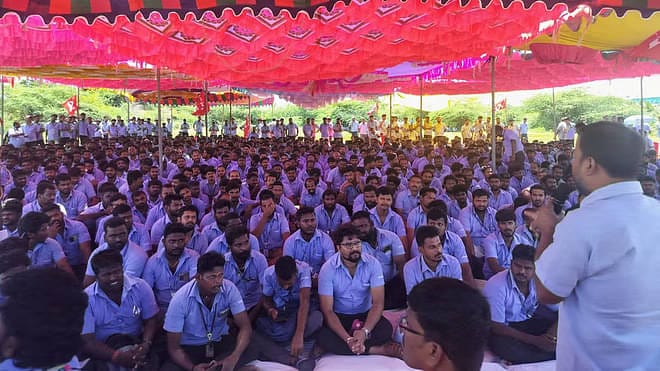
The states of Tamil Nadu, Odisha and Telangana were only moderately impacted. In Tamil Nadu, a large group of protesters attempted to block railway tracks around Trichy Junction, leading to scuffles with police and the detention of many demonstrators. But despite such attempts, public transportation largely continued without a major shutdown. There were instances of workers being threatened by their bosses not to join the protests, on pain of suspension.
In Jharkhand, there were street demonstrations outside major coal companies and Public Sector Undertakings. In the state of Odisha, trade unions held peaceful rallies and demonstrations, with slogans chanted against the Labour Code and privatisations. There were some instances of picketing and roadblocks, but no large-scale movement. In other cities, strike turnout was very limited. In Delhi, for example, there were no major disruptions. Railways, transportation and other institutions went on normally.
What we can say is that the strike failed to translate the undercurrent of discontent in Indian society into organised mass action. Certainly, it was far weaker than the previous bharat bandhs in 2020 and 2022, which both brought over 200 million people onto the streets. It also failed in its express goal of forcing Modi to repeal the Labour Code. Despite this, the trade union leaders called the strike hugely successful. How can we make sense of this gap between the leaders’ words and the facts?
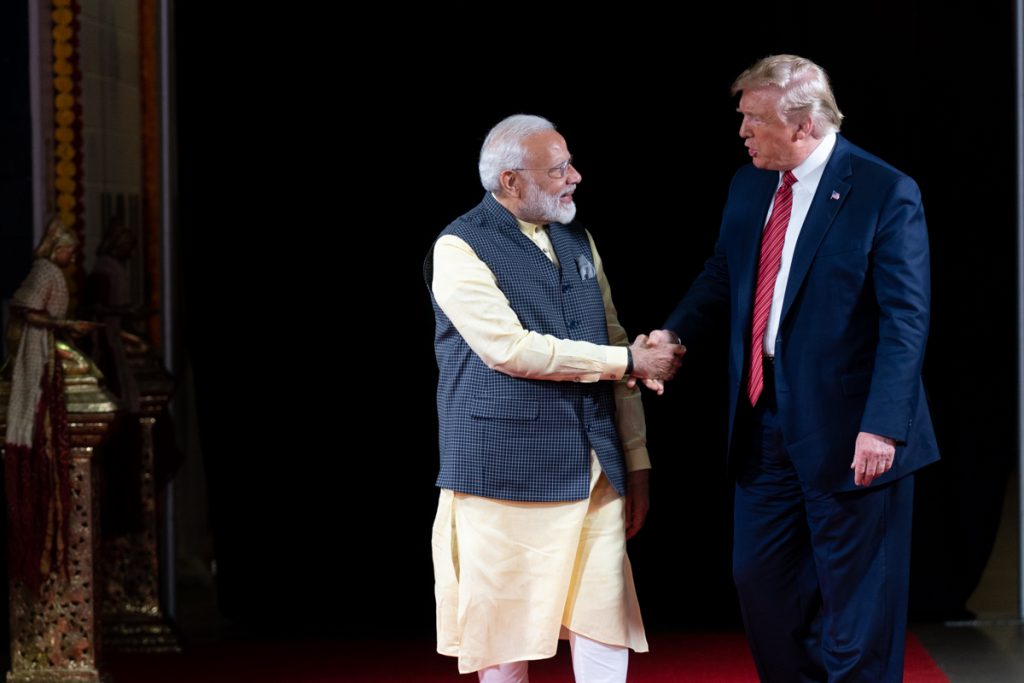
Modi’s Hindu nationalist government has increasingly revealed that it is firmly aligned with powerful corporate interests at home and imperialist forces abroad / Image: Trump White House, Flickr.
Anger of Indian workers
The first thing we should say is that there is no objective reason that the strike underperformed, given the level of anger amongst the Indian masses.
Modi’s Hindu nationalist government has increasingly revealed that it is firmly aligned with powerful corporate interests at home and imperialist forces abroad. Its policies have deepened inequality, weakened labour protections, and intensified agrarian distress, all while consolidating wealth and power among a tiny elite. The government has crushed workers, farmers, and the struggling middle class.
Modi’s treacherous, unequal India-US and India-EU trade deals – which prostrate the country to foreign markets and risk decimating the agricultural and textile sectors – coupled with the new Labour Code, continue the BJP’s campaign to reduce the Indian masses to cheap raw material for exploitation.
A mood of discontent against the political and economic establishment persists among broad sections of the population. The recent, rapid rise in the membership of the trade unions shows the Indian masses moving towards their traditional organisation as a means of self-defence, although the unionised workforce still only comprises 10 percent of the total.
But the main limiting factor is the conservatism of the bureaucratic trade union leaders, who restrain the working class to symbolic gestures that fail to galvanise the fury in society into a serious challenge to Modi and the Indian ruling class.
There was no plan to escalate the strike beyond a single day of action. There was no serious fight prepared to reverse the Labour Code or achieve any of the workers’ other demands. It was basically used as a release valve for the tension in society. This is exactly the same routine action the working class has seen before, which helps to explain why the turnout was lower this time. The workers know these single days of action do not get results, so millions of them simply shrugged their shoulders.
The blame lies with the trade union bureaucracies, who have squandered the fighting potential of the working class with these bankrupt methods. This process of the betrayal and demoralisation of the ranks did not start on 12 February.
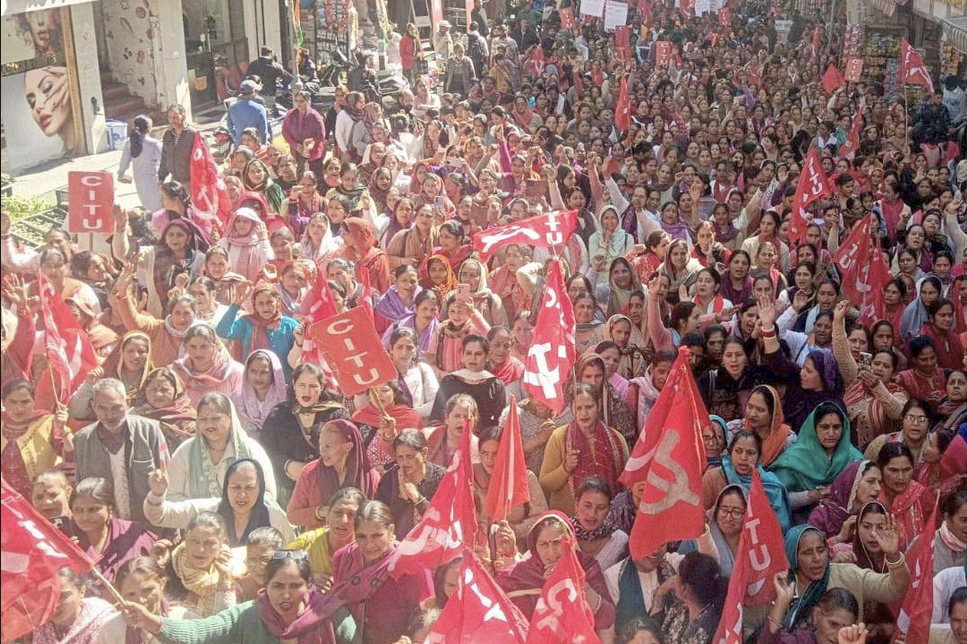
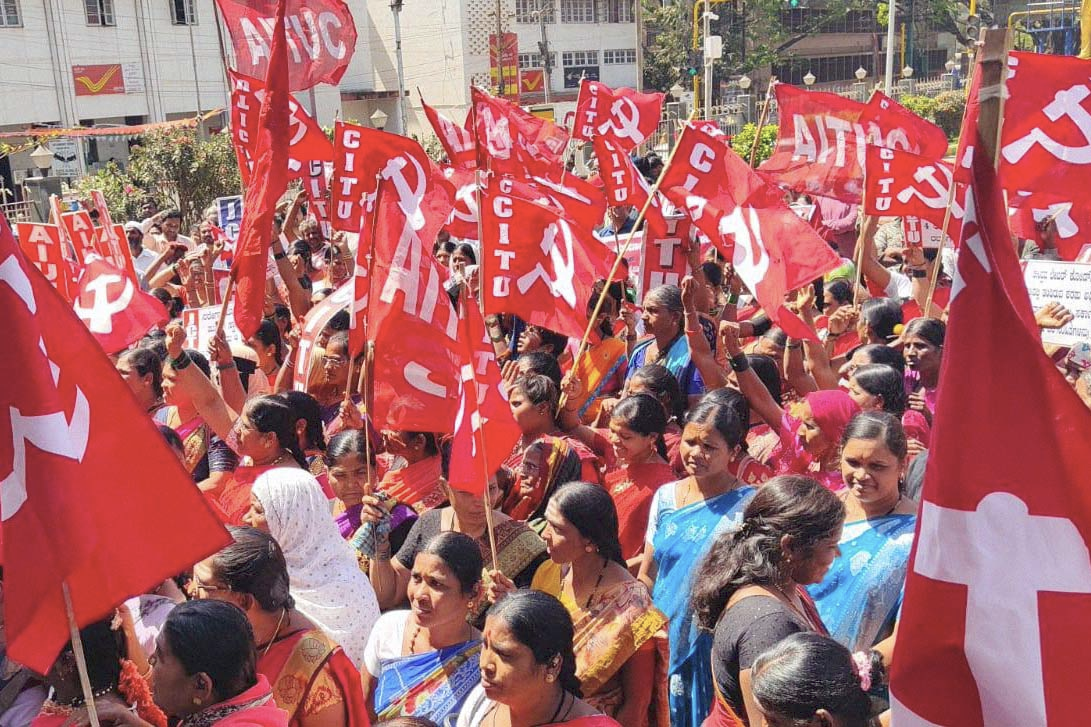
Let it never be said the Indian working class lacks the will and means to fight back / Image: CITU, Facebook.
Failures of leadership after independence
Since independence, India has witnessed numerous general strikes. While many have achieved partial gains, most have remained largely symbolic in their overall impact. In contrast, the recent nationwide farmers’ protest demonstrated the power of sustained and organised mass mobilisation. After prolonged agitation, the movement achieved a significant victory, culminating in the repeal of Modi’s three farm laws. Why have the labour organisations failed to replicate this success?
The situation did not emerge overnight. It is the result of a decades-long process. From the early 1940s to the 1970s, India witnessed a militant phase of labour action. Trade unions expanded across industries, and workers increasingly organised themselves around questions of wages, conditions, and workplace rights.
However, the trade union bureaucracies and the Stalinist parties to which many were affiliated always prevented a decisive struggle with Indian capitalism, meaning that these struggles always had a defensive character.
When Indian capitalism entered into crisis in the ‘80s and early ‘90s, culminating in the collapse of the Chandra Shekhar government and the assassination of Rajiv Gandhi, the bourgeoisie was forced to move decisively against the workers.
Economic liberalisation followed, which was a major setback for the unions and the working class. The Congress government of P. V. Narasimha Rao carried out a series of ‘reforms’ that opened India to foreign markets, accelerated privatisation and weakened organised labour. The 2000s saw a rapid rise in contract labour and informal employment, further undermining union power.
Today, nearly 90 percent of India’s workforce is employed in the informal sector, often without job security, written contracts, or social protections. This shift has fundamentally altered class relations, dispersing workers across fragmented workplaces and making collective organisation far more difficult than in earlier decades.
It was this process, based on the hyperexploitation of Indian workers, that facilitated the country’s ‘remarkable’ economic growth, and stuffed the pockets of the country’s billionaires, while leaving hundreds of millions to languish in poverty.
No serious struggle was mounted against this by the Indian trade union leaders. Meanwhile, the corruption and class collaborationism of the so-called communist parties, which previously had a mass base, created space for Modi’s brand of Hindutva chauvinism to divert people’s anger towards religious minorities and oppressed castes.
Today, the left parties all collaborate with the Congress Party, which spearheaded the destruction of workers’ rights after 1991. The ‘lefts’ justify this betrayal with the excuse of fighting Modi’s ‘fascism’ and protecting India’s constitutional democracy. We also saw, during the brief war with Pakistan a year ago, how the unions and communist parties all called a class truce and rallied around Modi in order to defend ‘the nation’.
All of this has had a cumulative demoralising and demobilising effect. In the absence of any political alternative, and given the exasperation towards ineffectual, symbolic gestures, the muted response to this latest bharat bandh is hardly surprising.
A new direction is needed
Let it never be said the Indian working class lacks the will and means to fight back. It is the largest working class on earth, with militant traditions. For all their limitations, the strikes of the last few years have still been the biggest labour mobilisations in history, and the farmers demonstrated in 2021 what can be achieved when the people’s rage is harnessed with an uncompromising plan of action.
The time has come for CITU and other major trade unions to move beyond symbolic protests. If the government refuses to address workers’ and farmers’ demands, an indefinite general strike should be seriously prepared. The unions must put forward their own comprehensive labour policies not merely to defend past gains, but to advance a clear alternative.
An indefinite general strike would not only confront the current right-wing capitalist government but also challenge the structural foundations of corporate power in India. Moreover, it should be a political general strike aimed at dragging Modi’s reactionary Hindutva mob out of power.
The recurring attacks on labour rights, agricultural protections, and public welfare are not isolated policies – they reflect deeper contradictions within Indian capitalism itself, which is incapable of carrying society forward.
A democratically planned socialist economy offers the only alternative path. By placing key industries, banks, and essential services under public control, it would prioritise social needs over private profit. Workers and farmers could gain access to universal healthcare, quality education, social security, and relief from crushing debt burdens. The struggle is not only against individual policies, but against a system that subordinates human welfare to capital accumulation.
If we want to change the world, we first need to understand it. The only way we can confront the situation facing us would be to develop a party which stands for the workers, farmers and toiling masses, based on the traditions and methods of Marxism. Help us to grow this force. If you are a real class fighter, then join us!