The closure of the Strait of Hormuz has provoked an energy crisis in India. This sudden, huge increase in the cost of living has sparked a wave of strikes all across the region.
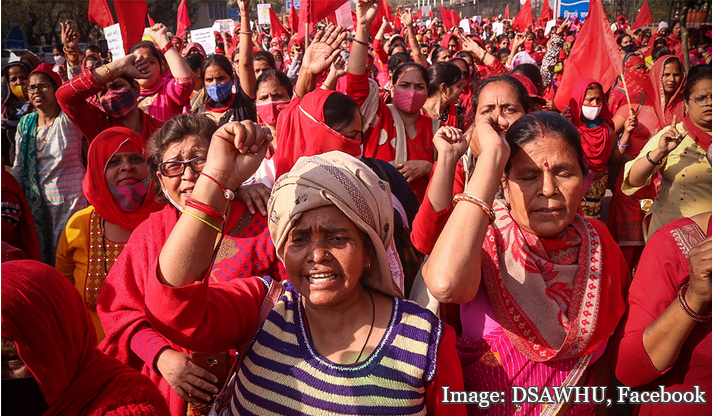
In the last month, strikes have spread across the National Capital Region (NCR), which has a population of 50 million people, and the surrounding regions. Nearly a hundred thousand workers are now on strike, with solidarity protests in support of them across the country. This inspiring, spontaneous movement of the Indian workers is just a foretaste of what is being prepared.
War in Iran triggers strike wave
Over the last decade in India, inflation has amounted to a cumulative 50 percent while wages have stagnated. A deep-seated class anger has been brewing for a long time.
Now, the war in Iran has provoked a worldwide energy crisis, disrupting 20 percent of oil supplies, placing huge pressure on the cost of living in India. India imports 60 percent of its Liquefied Petroleum Gas from the Gulf. As a result of this dependence, gas cylinders, officially priced at around ₹900, are now selling for as much as ₹4,000 on the black market. Industrial gas supplies have been cut under emergency orders, forcing factories to reduce output. 550 kilns have shut down in the pottery industry in Gujarat. Certain industries have begun rationing fuel. The government only acknowledged the situation was ‘worrisome’ on 18 March, two weeks after the Strait was blockaded.
This intolerable situation was the spark that lit the flame. It began in late March and early April, when workers in the state of Haryana’s automotive and electronics industries began agitating over the cost-of-living crisis. They were demanding ₹20,000 a month. This is not a demand for comfort: a worker’s family expects to spend ₹5,000–6,000 on rent, ₹8,000–10,000 on food, and ₹3,000–4,000 on gas. That’s already ₹20,000, before electricity, transport, phone, school fees, or medicine. They are demanding to break even.
Subsequently, on 9 April, the Haryana government conceded a 35 percent increase in the minimum wage, pushing pay for unskilled labour to ₹15,221 a month. This concession, intended to defuse unrest in one state, set off a wave of class struggle in the next: workers across the border in Noida – earning roughly ₹11,313 a month for the same kind of work in the same National Capital Region – asked the obvious question: ‘why should we work for ₹6000 less?’
On 9 April, garment workers at Richa Global in Noida walked out. The next day, a sit-in began in Phase 2, the hosiery complex. Over the following weekend, the protest grew. By Monday 13 April, workers from dozens of companies – Dixon, Motherson, Selcom, Sparky, QCL, and many others across electronics, garments, and auto components – flooded the streets across five sectors and into Greater Noida.
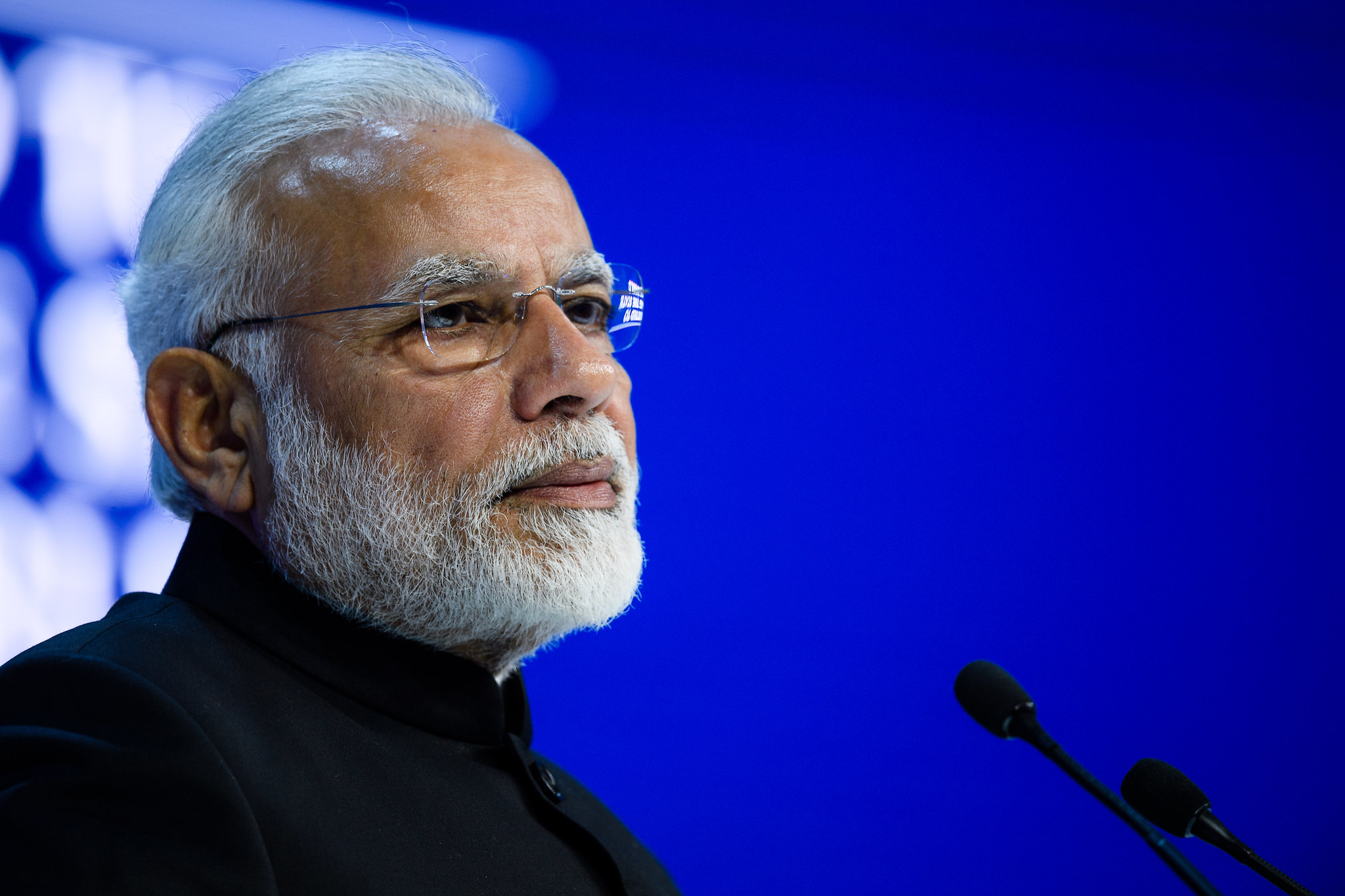
One of the key companies involved in the unrest is Dixon, a smartphone and smartwatch manufacturer. Dixon is India’s largest enterprise of this type, and is a darling of Modi’s ‘Make in India’ initiative, intended to re-shore technical jobs. The company is a key beneficiary of the PLI (Production-Linked Incentive) scheme for large-scale electronics manufacturing, launched in April 2020. The scheme pays companies for sales, explicitly to encourage domestic manufacturing. Its Mobile division alone posted revenue last year of ₹33,043 crore (₹330 bn, approx $3.5bn) (up 203 percent year on year) with operating profit of ₹1,153 crore.
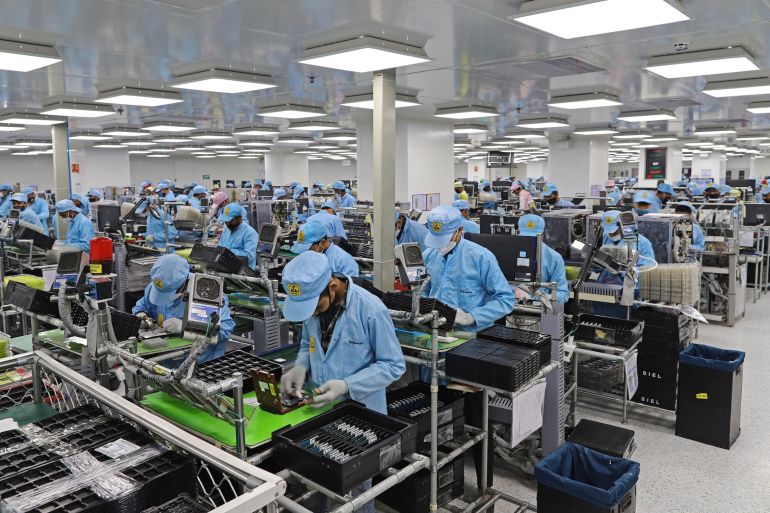
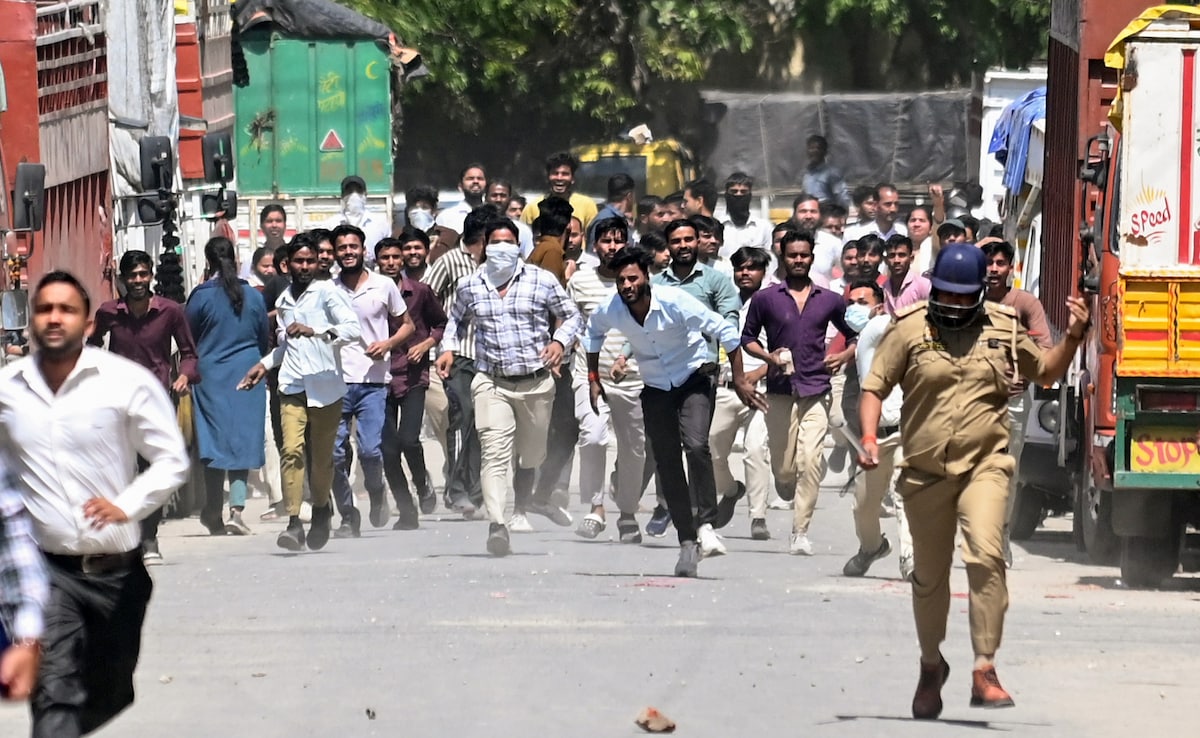
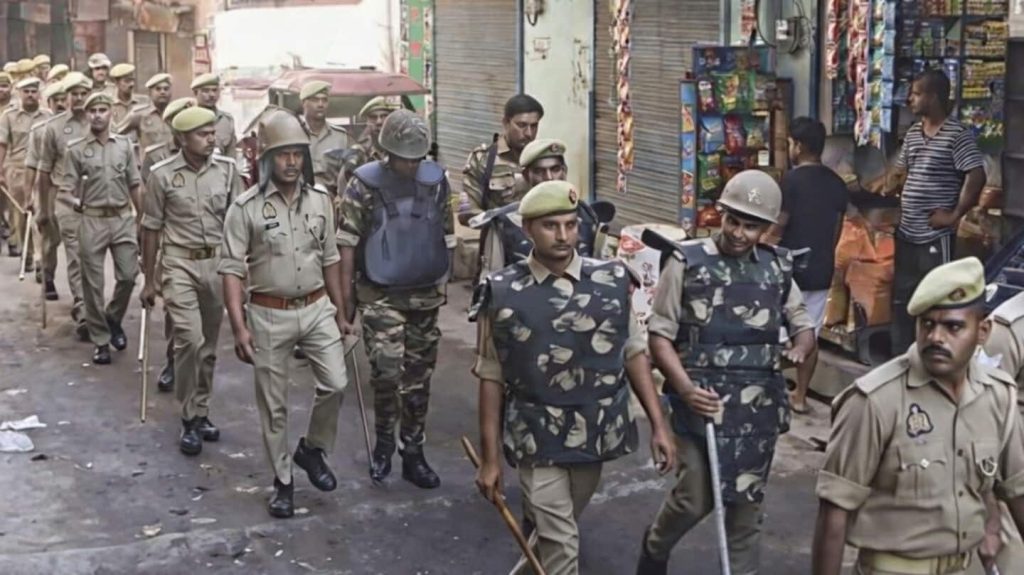
The workers there were promised wage rises on 1 April. Having not received them, a sit-in and picket began on 10 April. Hired thugs indiscriminately beat the workers on Monday 13 April. This led to huge outrage and riots outside the workplace, which the police further cracked down on. The Week reports that a woman was shot by police, and that tear gas was also used. Jist, a YouTube news channel, went to interview workers on the scene on the afternoon of the attacks. On camera, the police can be seen rounding up the picketers and bussing workers away at the request of the bosses. One of these esteemed ‘keepers of the peace’ can be seen striking a reporter with a baton. Women and children have been beaten. 466 workers have been arrested.
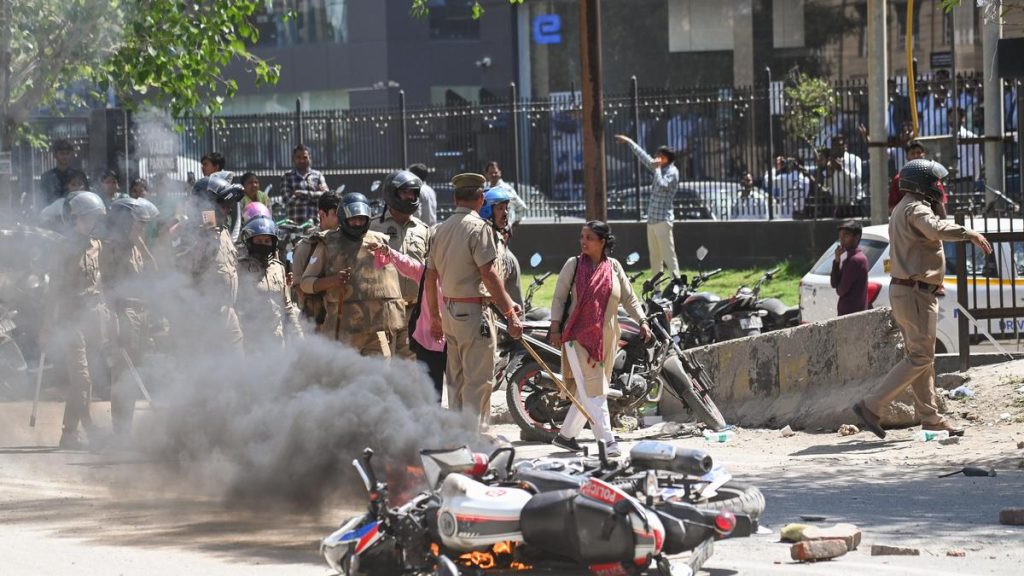
Worker testimonies collected by The Federal in Sectors 59–63 describe a rampage, not a dispersal. The lathi [baton] charge extended well beyond the protest site. Rohit Kumar, a worker at Sparky, Sector 149, had finished his shift at 1pm and was walking home when police beat him on the head and legs. He was not protesting, but ended up bleeding from the skull. In an interview with The Federal, another woman described how:
“The police in Uttar Pradesh have become uncontrollable. I was going home with my child. The police beat me and did not spare my child either.”
Another Selcom worker said:
“I was also going home after my shift. The police treated women very badly too. We were injured by repeated baton blows. We work at Selcom company and were protesting peacefully.”
On the front lines
The testimonies given by workers present summarise the mood on these pickets. One worker at Dixon said to Jist:
“The pay last went up in 2019. Since then we have had COVID, the price of everything has gone up, how are we meant to live? We have no gas to cook our food, what are we supposed to do?”
Another worker commented.
“They promised us that we would receive a pay rise on 1 April. It’s currently the 13th. They keep cutting our holidays. We did not receive Holi (4 March) off. They really torture us in there. They swear, berate and insult us. What are we meant to do with 12,000 [rupees a month]? 5000 goes on rent. 5000 on gas. What are we meant to do with the rest? Solderers get 12-13,000, others get closer to 11,000. But even from that, they regularly deduct our pay”
A male labourer said:
“We simply want a salary of ₹18-20,000. The economy has gotten a lot worse. ₹11,000 is nothing. We will stay out here until we get it.”
The bosses, he continued, are:
“…too scared to come out and talk to us. The leadership come and go by sneaking out the back door.”
The exploitation at Dixon is not purely economic. A young woman at the pickets commented:
“The managers make advances towards us. When we don’t respond to it, the next day we are berated. They curse at us and say we should be thrown out.”
This is the reality of life as a worker in a company lauded by the Modi government. Women bear the brunt of this abuse and poverty. Housemaids and cleaners in Noida have also been on strike this week, protesting the same cost of living crisis and contemptuous treatment by employers: being shortchanged, being mistreated on caste lines, and beaten and harassed by police on their protests.
One striking household cleaner said:
“The police don’t care about us. They [the employers] have them on speed dial. Anything small happens, the cops are there. They serve the rich. Not us.”
These are the conclusions workers in the capital are reaching.
Solidarity protests
The CITU (a Communist Party-affiliated trade union) organised a national demo in solidarity with the striking workers. For this heinous crime, its leaders were placed under house arrest. This is a sign of the panic and fear of the Indian state in the face of this wave of class struggle.
The protest spread across India, across neighbouring towns – like Panipat, Manesar and Sonipat in Haryana, Bhiwadi and Neemrana in Rajasthan, Surat, Hazira in Gujarat and Barauni in Bihar – and then to 11 of the 28 states in India – from Jammu and Kashmir in the North to Assam in the East, Himachal Pradesh, Kerala, Bihar, Kharkand, Hyderabad and more.
This is the broadest spontaneous workers’ movement in India since the 2020 pandemic migration crisis, and possibly since the 2016 general strike. The plight of the NCR workers is striking a chord with workers in other affected industries. Just down the road from Surat and Hazira is Morbi, in Gujarat, the ceramics capital of India. There, the fuel crisis has put workers out of work in 550 factories.
Ten percent of the entire GDP of Uttar Pradesh comes from the Noida region. The nearby regions, which are currently racked by protests and demos, alone correspond to approximately 3-4 percent of India’s total GDP.
Pakistani conspiracy?
It is the widespread solidarity – and the huge potential economic ramifications of it – that is keeping the Indian ruling class in a state of panic. This is why a huge uproar is being whipped up about the influence of ‘Pakistani agitators’ – the go-to excuse for the Indian state. Allegedly, these agitators have created this movement out of thin air… and WhatsApp QR codes.
Videos of burning cars and bikes are disseminated without context. The bosses at Dixon, Samvardhana Motherson, etc. speak in the press, calling the strikes ‘industry-wide’ events driven purely by ‘misinformation’.
The police’s own evidence refutes their conspiratorial narrative. The most incriminating material they have produced is an Instagram group chat encouraging workers to carry chilli powder, in case of a lathi charge. That is not evidence of a conspiracy. It is evidence that workers knew exactly what the state would do to them. They were right.
This propaganda spread by the state is obvious nonsense. It shows the real purpose of the constant fearmongering with regard to Pakistan: to divide workers and sow doubts amongst their ranks. They aim to make honest workers fear that ‘violent’ and ‘dishonest elements’ lie within their ranks.
One worker’s words cut through all of the lies:
“We have been out here since 8 am. No one has come to see us. All of our trust has been destroyed. From the government, from the media, from everyone. No one is actually talking to us and hearing our demands. Why does it pay and promote these companies and do nothing to help us live? What do they think, that we’re born just to vote for them?”
The state, however, has persevered with this manufactured outrage. Aditya Anand, a software engineering graduate who quit to become an activist to report on conditions in Noida and organise the workers, has been arrested in Tamil Nadu as the alleged ‘mastermind’ of the unrest in Noida. A ₹1 lakh bounty (around $1,070 USD, or 9-12 months’ pay for a worker at Dixon) was placed for his arrest.
This is an outrageous act of repression by the state, which views the workers in Noida as too stupid or docile to organise on their own. The Revolutionary Communists of India wholeheartedly condemn this arrest. We demand the release of Anand and all the workers who have been arrested.
What next?
The implication is that if the workers behave themselves and quench their anger, the bosses will give them what they need. This is nonsense. Out of fear of the anger the bosses have unleashed, a hike of 21 percent in the minimum wage in the NCR has been announced by the government. This adds ₹2-3,000 to the workers’ pay, backdated to 1 April. But this still leaves wages at 70 percent of what the workers demand just to stay afloat, and is just half of what the CITU has raised as a demand.
Shamelessly, the employers themselves are claiming that the pressure of the Iran War means they cannot afford to meet this meagre sum. We say: show us the proof! Let the workers in each company across the NCR look over the books. Then we will really see what they can and cannot afford. Workers themselves should decide how these pay rises can be paid for. If companies cannot afford to keep running without slave wages, then the bosses must be the first to be fired, and the factories put under democratic workers’ control!
This cannot be achieved by following the advice of the bosses, which is to keep quiet and appeal to their ‘generosity’. Only through a serious, concerted struggle to the end, to win the demands of ₹20,000 and more. The movement that has rapidly spread across parts of the National Capital Region and the wave of solidarity protests that have followed it are a sign of the mood amongst the masses for just such a determined struggle.
A militant struggle led by the trade union leaders could transform the situation entirely, placing enormous pressure on the states and Modi’s government itself. Far more than 21 percent, workers across this region could win huge raises in the minimum wage, if and only if a serious leadership were present and willing to make the most of this movement.
Concretely, this means demanding:
- No return to work until the Noida workers win ₹20,000 a month
- Release Aditya Anand and all the arrested workers!
- The end of the house arrest of the CITU leaders
- No victimisation of striking workers, which must be enforced through union control of hiring and firing in the NCR.
- Open the books! If the bosses claim ₹20,000 a month is not possible, the workers in the factories must be shown the finances and make decisions themselves on how to afford the pay rises.
- Pay the wages or pay the price! Factories that cannot pay a living wage must be expropriated and put under democratic workers’ control.
What is clear is that this demonstration is another instance of a wider phenomenon. The spiralling price of energy is widening inequality and worsening the conditions of the poor. It was conditions like these that led to the Gen Z revolutions in all the countries surrounding India: Sri Lanka, Bangladesh, Nepal and Myanmar.
India is no exception to this trend, and events like the current strike wave are a portent of what is to come.
At Dixon Technologies – Modi’s model company, in Modi’s model district – a worker earning ₹12,000 a month asked: “what do they think, that we’re born just to vote for them?” Anecdotes such as this give a snapshot of the growing mood of hatred of the establishment that is developing across India.The Indian working class is one of the largest in the world. This week, they have managed to win concessions and spread the movement despite its spontaneous character and heavy state repression. This is only a glimpse of what the Indian working class will be capable of once it is organised.