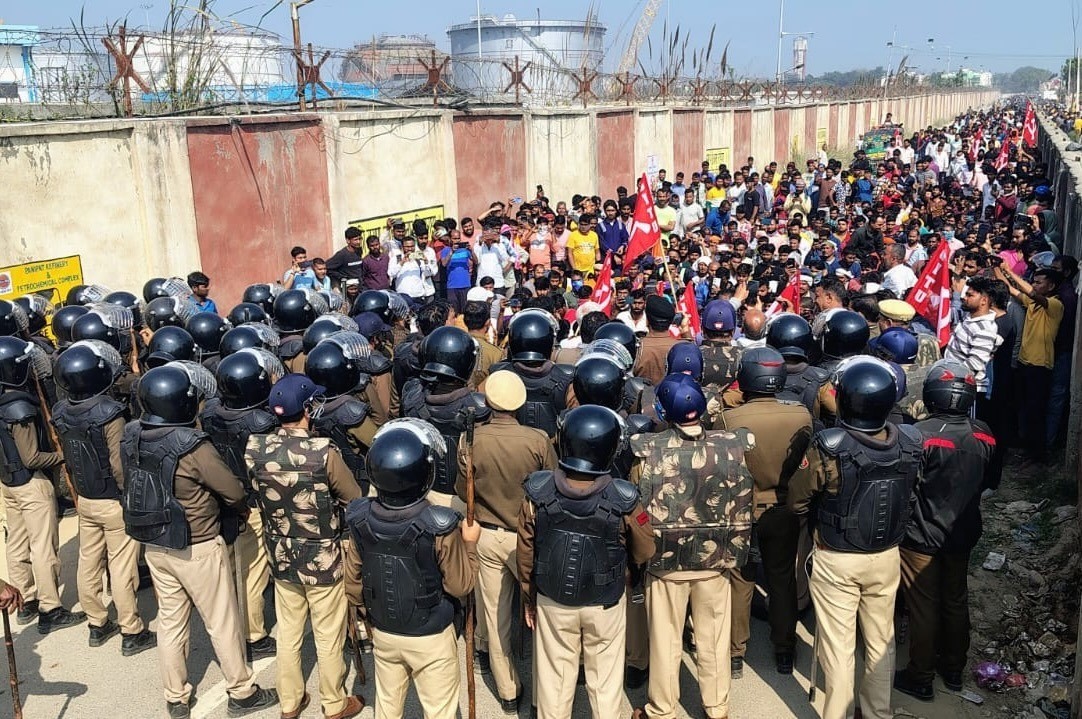
On 23 February, 40,000 workers at IOCL (Indian Oil Corporation Limited) at the Panipat refinery expansion project in Haryana went on a strike, which spread across the entire premises. The sudden, radical action was met with a vicious police crackdown and an internet blackout.
The government scrambled to erase the protests from the mainstream media. Unsurprisingly, and in full subservience to their capitalist overlords, the Indian corporate media covered the incident as a ‘violent clash’ or ‘security incident’ rather than a powerful, spontaneous struggle for labour rights.
Straw that broke the camel’s back
Events were set in motion on 21 February, when a workplace accident at the refinery resulted in the death of two workers and severe injuries to a third, who required a leg amputation. Workers alleged that neither ambulances, nor quick medical help was permitted by the contractors or the management. This was the immediate trigger for the massive strike at the Panipat refinery and its expansion site.
This confrontation was not an unexpected development, but rather a result of years of accumulated anger amongst the workers of the refinery due to rock-bottom wages, dangerous working conditions and grueling 12-to-16-hour workdays. The workers report that overtime wages were not being paid according to the legally-required double wage rate.
They also claimed that their paycheques are often delayed by up to three months, and they have little to no financial security due to irregular provident fund deposits and no job security. The workers also reported inadequate toilets, drinking water and hygiene facilities.
The strike was largely spontaneous, without any centralised leadership. But it struck a chord with thousands of workers who carried out this massive protest united as one political force – much to the alarm of the management.
The continuous and protracted exploitation and humiliation of workers found a voice of expression in this protest. Workers contracted by major companies like L&T (Larsen and Toubro) downed their tools and gathered at the entrance of the refinery with the following demands:
- Reduction of shifts from 12 hours to the legally required 8 hours.
- Payment of overtime working hours at double rates.
- Timely wages (between the 1st and 7th days of each month).
- Regular and correct provident fund (PF) contributions (allegations of fraud or deductions are common).
- Basic facilities: clean toilets, drinking water, hygiene and on-site medical support.
- Broader calls against exploitation, including better leave policy (currently they only get two days of leave per month, including forced work on Sundays).
The protests took several forms, involving sit-in-demonstrations (dharnas), work stoppage, mass gatherings, and meetings with officials and contractors. At one stage, the protest also spilled over to the region outside the premises after the workers gathered near the entrance of the refinery expansion. The situation escalated to the point where some protesters allegedly threw stones and damaged some vehicles, possibly belonging to security personnel near the site.
In response, the personnel of the Central Industrial Security Force (CISF) reportedly fired two warning shots into the air in an attempt to disperse the crowd. Besides the warning shots the police also carried out a lathi charge to disperse the protesters – deploying naked force against protesting workers who are fighting for their rights.
Authorities reportedly filed First Information Reports (FIRs), opening police investigations against 2,500 workers involved in the protest and five individuals were arrested – two activists and three workers. Apart from arrests and lathi charges, it is reported that mobile network jammers were installed around the refinery area in an attempt to prevent photos and videos of the protest from spreading online. Despite massive blackouts, workers were able to put videos of this massive strike on online social media platforms.
This meant the action had a spillover effect and a massive strike broke out at the ArcelorMittal Nippon Steel (AM/NS) plant project in Hazira, Gujarat on 26 February. Around 2,000 to 5,000 workers who were employed by L&T, one of India’s largest EPC contractors (Engineering, Procurement, Construction), began discussing similar grievances about wages and working hours after seeing the videos of the Panipat strike, and large groups gathered spontaneously at the Hazira site.
This was also possible because contract labourer networks across different sites are closely connected through social media platforms. Here too, the strike started just as a gathering which escalated into stone pelting at police, vehicles being damaged, and at least one car being set ablaze. The police fired tear-gas shells to disperse the workers, and several were arrested. FIRs were filed for property damage and rioting.
Both of these developing protests were halted due to severe state repression, blackouts and police detentions. Since the majority of the workforce are migrant labourers and work on meager wages, most of them had to continue working even on the next day. But nothing has been resolved and it is inevitable that the workers’ rage will boil over again.
Capitalism to blame
IOCL is India’s largest government-owned oil and gas company, and is classified as a CPSE (Central Public Sector Enterprise). The government of India owns 51-52 percent of the shares, while the remaining shares are held by various other companies and private owners. It plays a central role in producing, refining, transporting, and selling petroleum products across India.
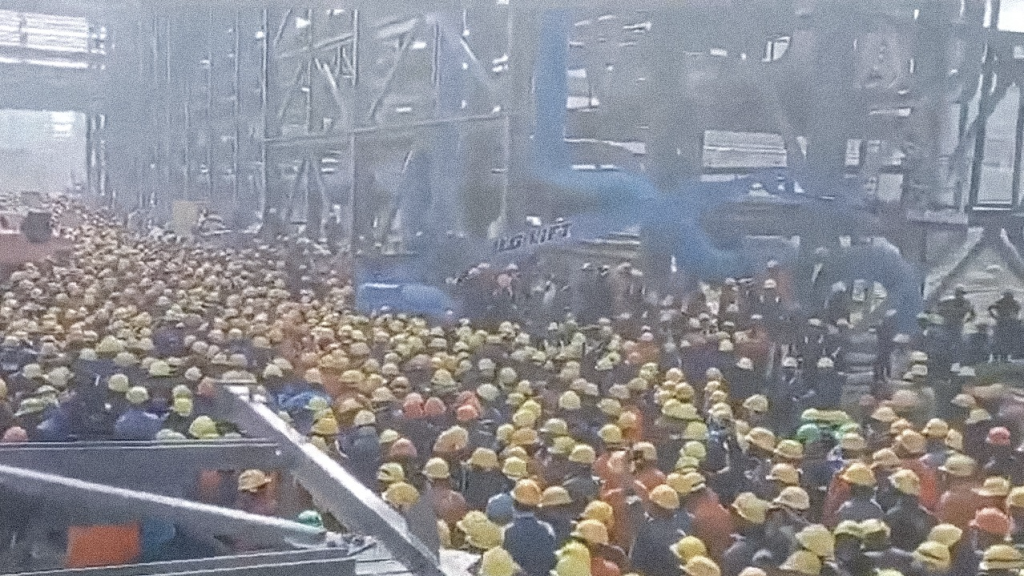
The developing protests were halted due to severe state repression, blackouts and police detentions / Image: fair use.
Despite being a state-owned company, it recruits employees through third-party contractors. They follow a multi-layered contractor system: at the top is the project owner, IOCL itself, which gives contracts to EPC contractors such as L&T. The EPC contractors do not hire workers themselves, rather, they divide the project into smaller sections or ‘packages’ and award them to subcontractors. Each subcontracted package can include anything ranging from civil construction, pipeline welding, structural steel, electrical works, scaffolding, insulation and so on.
Each subcontractor hires hundreds or thousands of workers, and many subcontractors further hire labour contractors who directly recruit workers from villages or other states, arrange for their accommodation and transportation, and pay these migrant workers daily wages or monthly salaries. In this labour procurement setup, the workers usually have no direct employment relationship with IOCL. In effect, this system facilitates privatisation of state companies by the backdoor.
Because of these multiple layers, the authorities often try to dodge responsibility for the actions of contractors, meaning they are not liable for workers’ grievances. Not only IOCL, but the majority of Public Sector Undertakings recruit employees on this basis, dividing workers into smaller battalions, and leave them on their own to deal with the parasitic, irresponsible and corrupt contractors and subcontractors, who pay the least possible wages and exploit these workers to the maximum possible extent.
The recent dilution of labour laws is designed precisely in the interest of these contractors and private companies. It is a tragedy that the leaderships of India’s main trade union confederations undermined the impact of the recent general strike against this reactionary legislation by limiting action to a single day, rather than building for a sustained offensive against the Modi regime. But as we see with these two spontaneous eruptions, Modi’s attacks will push workers into defensive struggles for their rights and interests, with or without a lead from the top.
We express our full support for the protesting workers of IOCL, and emphasise that the situation they face is a product of a system that necessarily creates inhuman and exploitative conditions for workers. The struggle of the IOCL workers is therefore a sign of future battles to come.
A genuine revolutionary leadership should expose the root of these problems: capitalism, which is the source of hyperexploitation in both the informal and formal sectors of the Indian economy. A bold solution is called for, one that goes beyond localised action and performative national strikes, and forges workers’ struggles into a united battle against Modi’s Hindutva regime and the bourgeois thieves it represents.
These small and spontaneous protests have demonstrated the extraordinary courage of Indian workers, who have all the necessary potential to change the world they live in. The workers must ask this simple but powerful question – if we make the society function through our collective labour, then who should run society? Is it us, or the capitalists and their lapdog management?
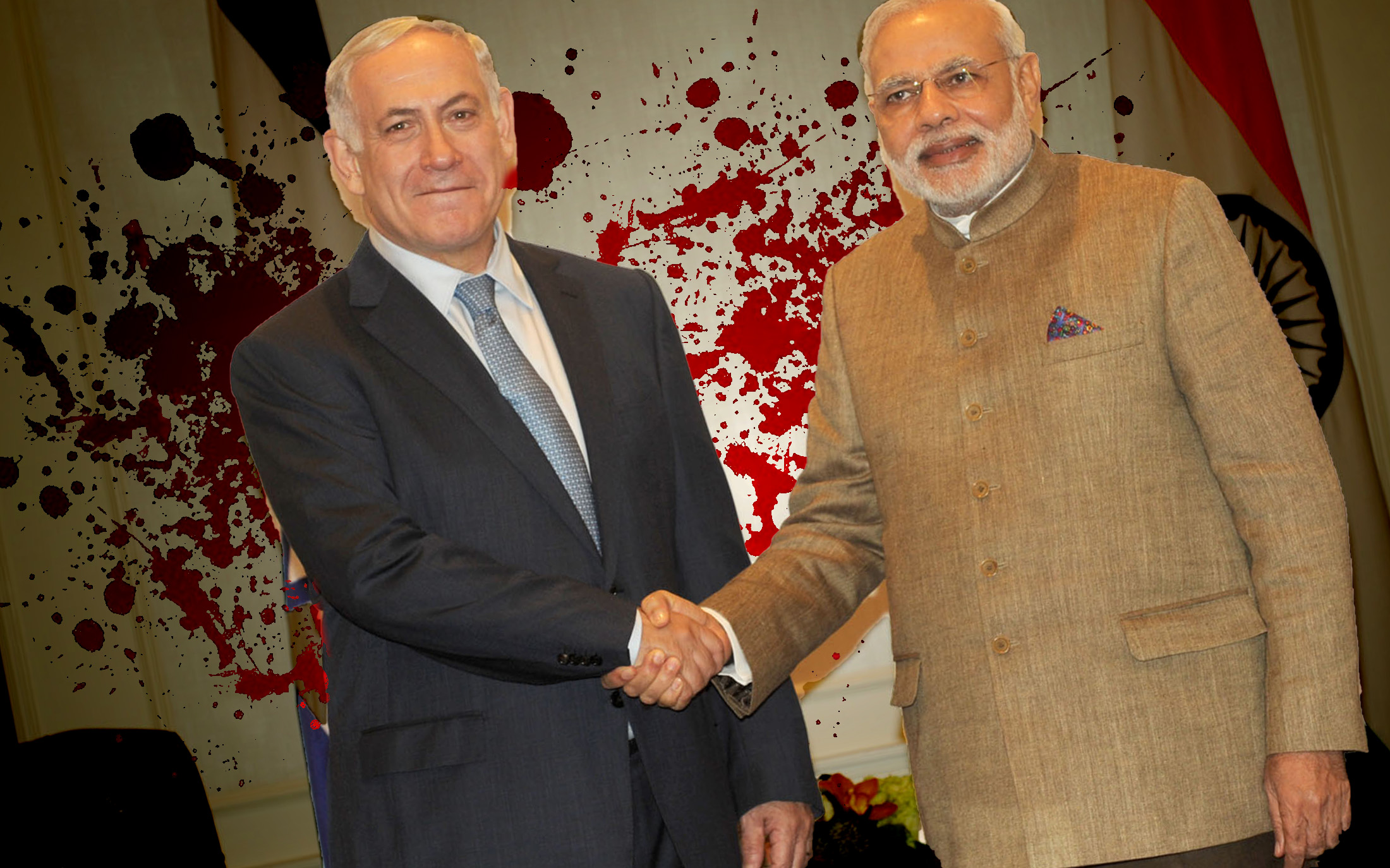
Especially now, refinery workers in particular have tremendous potential power in society. The US is temporarily waiving its embargo on buying Russian oil in order to refine it in India, thus bringing global prices down amidst the insanity of the Iran War: which the US and Israel started, and which Modi supports. India’s oil workers thus have their hands on one of Modi’s most important economic levers, and a major bargaining chip. All that is lacking is the necessary leadership to translate this immense power into a relentless battle for victory.
Down with the capitalist state and its minions! All for workers’ ownership of industries! Those who labour for society should be the ones who should rule it! All for revolution! Help us build the forces of genuine Marxism and revolution in the RCI! Inqilab zindabad!